Auto Dealership Positions: Roles, Responsibilities, and Career Opportunities
Introduction
The automotive industry is not just about cars; it’s a dynamic world filled with exciting career opportunities. If you’re looking to jumpstart your professional journey, auto dealership positions might be the perfect fit for you. From sales and service to management roles, dealerships offer a variety of paths that cater to different skills and interests. Whether you have a passion for helping customers find their dream car or an eye for managing operations efficiently, there’s something in this field for everyone. Let’s explore what these positions entail and how they can shape your career!
What Are Auto Dealership Positions?
Auto dealership positions encompass a variety of roles critical to the successful operation of a car dealership. Each position plays a unique part in delivering an excellent customer experience and ensuring smooth internal processes.
From sales teams that engage potential buyers to service departments that maintain vehicles, every role contributes to overall success. Positions can range from front-line staff interacting with customers to behind-the-scenes experts managing inventory or finances.
These jobs require a mix of skills, including communication, technical knowledge, and customer service acumen. Whether you’re passionate about cars or eager to help others find their ideal vehicle, there’s likely a niche for you within this vibrant industry.
As the automotive landscape evolves, so do these roles—adapting to new technologies and changing consumer preferences. This dynamic environment offers exciting opportunities for growth and development in various career paths.
Top Auto Dealership Positions
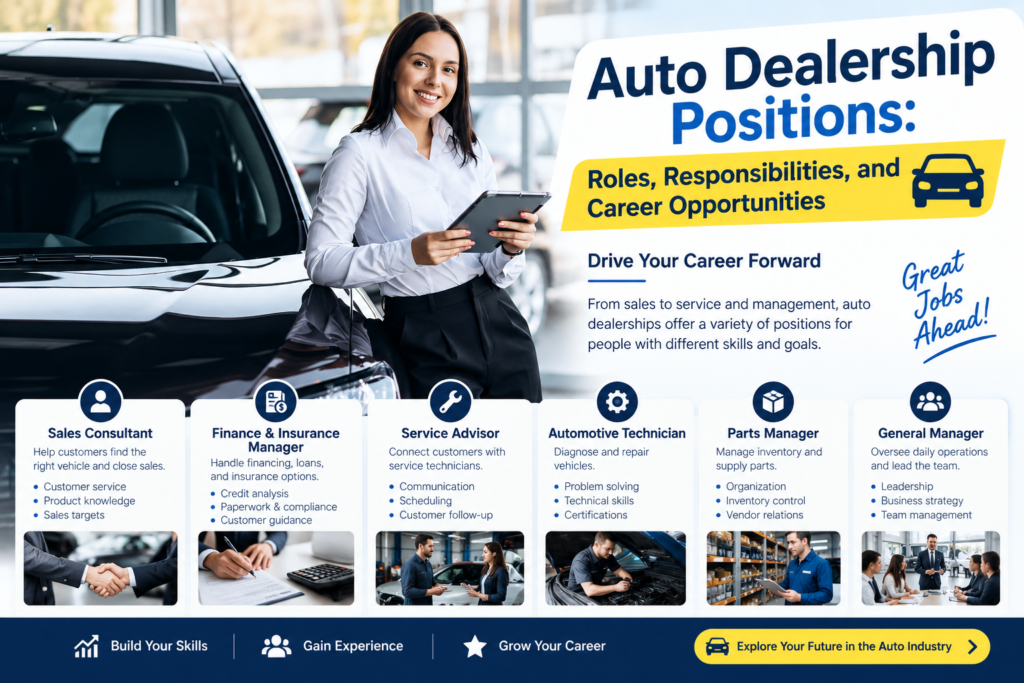
Auto dealerships offer a variety of career paths, each with its unique responsibilities and rewards.
One prominent role is that of an Automotive Sales Consultant. These professionals are the face of the dealership, guiding customers through their vehicle purchasing journey.
Another key position is the Sales Manager, who oversees sales teams and strategies to drive business performance.
The Finance and Insurance (F&I) Manager plays a critical role in securing financing options for buyers while also managing insurance products.
Service Advisors bridge customer needs with technical solutions, ensuring vehicles receive necessary maintenance and repairs.
Automotive Technicians work hands-on, diagnosing issues and performing repairs to keep cars running smoothly.
Parts Advisors manage inventory levels, helping ensure that technicians have access to the necessary components for repairs.
Dealership General Managers oversee all aspects of operations, from sales to service departments. Each position contributes significantly to the overall success of a dealership.
Automotive Sales Consultant
An Automotive Sales Consultant plays a crucial role in the dealership’s success. This position involves interacting directly with customers, understanding their needs, and guiding them toward the right vehicle.
These consultants must have strong communication skills to effectively convey information about features, financing options, and promotions. Building rapport is essential; customers appreciate genuine interactions that make them feel valued.
Product knowledge is critical for this role. An Automotive Sales Consultant should stay updated on industry trends and new models to provide informed recommendations.
Sales strategies are important too. Consultants often use techniques like upselling or creating urgency without pressuring customers excessively.
Success in this position can lead to career advancement opportunities within the dealership structure, making it an appealing choice for many individuals looking to grow in the automotive industry.
Sales Manager
The Sales Manager plays a pivotal role in any auto dealership. This position involves overseeing the sales team and driving overall performance.
A successful Sales Manager sets goals and develops strategies to meet them. They analyze sales data, identify trends, and implement effective techniques to boost sales figures.
Equally important is mentoring the sales staff. Training new hires on product knowledge and customer engagement can lead to improved success rates.
Sales Managers also foster relationships with customers. Building rapport ensures repeat business and referrals, which are crucial for long-term growth.
Communication skills are vital in this role as well. Coordinating between departments helps streamline processes and enhance customer satisfaction.
Another key responsibility lies in inventory management; ensuring that popular models are stocked while managing costs effectively keeps the dealership competitive in a dynamic market.
Finance and Insurance (F&I) Manager
The Finance and Insurance (F&I) Manager plays a crucial role in an auto dealership. This position bridges the gap between sales and finance, ensuring customers secure optimal financing options for their vehicle purchases.
A successful F&I Manager is skilled in various financial products such as loans, warranties, and insurance policies. They educate clients on these options while tailoring solutions to meet individual needs.
Building trust is essential in this role. F&I Managers must communicate clearly and effectively, helping customers feel confident about their choices.
They also work closely with lenders to negotiate terms that benefit both the dealership and its clients. Staying updated on industry trends is vital for recommending competitive rates or new products.
Strong attention to detail ensures all paperwork complies with regulations, reducing potential liabilities for the dealership. It’s a dynamic position that requires adaptability and strong interpersonal skills.
Service Advisor
The role of a Service Advisor is crucial in the auto dealership ecosystem. They serve as the vital link between customers and technicians, ensuring smooth communication throughout vehicle repairs or maintenance.
Effective Service Advisors possess excellent customer service skills. They listen to clients’ concerns, diagnose issues with precision, and recommend appropriate services. Their ability to empathize makes customers feel valued and understood.
Moreover, they manage appointments efficiently while keeping track of repair timelines. This ensures that vehicles are serviced promptly without compromising quality.
A solid understanding of automotive systems is essential for success in this position. This knowledge helps Service Advisors explain technical details to customers in layman’s terms.
Balancing multiple tasks—from greeting customers to coordinating with mechanics—is part of daily life for these advisors. It’s a fast-paced environment that rewards those who thrive under pressure and enjoy problem-solving challenges.
Automotive Technician
An automotive technician plays a crucial role in the auto dealership ecosystem. These skilled professionals diagnose and repair various vehicle issues, ensuring optimal performance for customers’ cars.
They utilize advanced tools and technology to identify problems efficiently. From routine maintenance tasks like oil changes to complex engine repairs, their expertise is essential.
Education often includes vocational training or an associate degree in automotive technology. Certifications from recognized programs further enhance job prospects.
Attention to detail and strong analytical skills are vital traits for success. Technicians also need good communication abilities to explain technical matters effectively to customers.
With rapid advancements in automotive technology, continuous learning is important. Staying updated on new systems can open doors to greater opportunities within the dealership environment.
Parts Advisor
The role of a Parts Advisor is vital in an auto dealership. These professionals are responsible for managing the inventory of automotive parts and accessories.
They assist customers, whether they’re service technicians or individual buyers, in finding the right components for their vehicles. This requires a deep understanding of car models and compatibility.
A Parts Advisor also processes orders and ensures that inventory levels are maintained. They often interact with suppliers to acquire necessary stock at competitive prices.
Excellent communication skills are crucial since they must explain complex part details clearly to customers.
Additionally, proficiency with inventory management software helps streamline operations. Strong organizational skills come into play as well when keeping track of incoming and outgoing parts.
By ensuring that all required elements are available, Parts Advisors contribute significantly to customer satisfaction and overall dealership efficiency.
Dealership General Manager
The Dealership General Manager plays a crucial role in the daily operations of an auto dealership. This position requires strong leadership skills and strategic thinking.
A General Manager oversees multiple departments, including sales, service, and finance. They ensure that each section runs smoothly to meet overall business goals.
In addition to managing staff, a General Manager is responsible for setting budgets and financial targets. Monitoring performance metrics is essential for identifying areas needing improvement.
Customer satisfaction also falls under their purview. A good GM fosters a positive environment where employees feel valued and customers are treated with respect.
Networking within the automotive industry can lead to new opportunities and partnerships. Staying updated on market trends helps inform decisions that keep the dealership competitive in a rapidly changing landscape.
Skills Needed for Auto Dealership Jobs
To thrive in auto dealership positions, certain skills are essential. Strong communication abilities stand out as a top priority. Interacting with customers, colleagues, and vendors is daily business.
Sales roles require persuasive skills to guide clients towards purchasing decisions. Understanding the product also plays a crucial role; knowledge of various vehicle features can enhance credibility and trust.
Problem-solving capabilities come into play regularly. Whether addressing customer concerns or navigating inventory challenges, quick thinking is valuable.
Adaptability is equally important in this fast-paced environment. The automotive industry evolves rapidly, so being open to change keeps you ahead.
Teamwork cannot be overlooked. Collaborating effectively fosters a positive workplace culture and enhances overall performance across departments. These combined skills create a well-rounded candidate for any dealership position.
Education and Qualifications
Education and qualifications for auto dealership positions can vary widely. For entry-level roles like automotive sales consultant, a high school diploma may suffice. However, having some college education or experience in retail can give job seekers an edge.
For more specialized positions such as service advisors or automotive technicians, formal training is beneficial. Many aspiring technicians pursue degrees from accredited trade schools or community colleges offering automotive programs.
Certifications play a crucial role too. Organizations like the National Institute for Automotive Service Excellence (ASE) provide credentials that showcase expertise and commitment to the field.
Management roles often require a bachelor’s degree in business administration or related fields. Experience in sales, customer service, and leadership also enhances prospects when pursuing these higher-level positions within dealerships.
How to Start a Career in an Auto Dealership
Starting a career in an auto dealership can be both exciting and rewarding. Begin by researching the different positions available to discover where your interests lie.
Consider taking automotive courses or certifications. These programs can provide valuable knowledge and skills that are beneficial in various roles.
Networking is crucial. Attend industry events, join local car clubs, or connect with professionals on platforms like LinkedIn. Building relationships can open doors for job opportunities.
Don’t underestimate the power of internships or entry-level positions. Gaining hands-on experience allows you to learn about the dealership environment while showcasing your work ethic.
Customize your resume to highlight relevant skills and experiences tailored specifically for automotive roles. A well-crafted resume catches attention quickly.
Prepare for interviews by researching common questions related to dealerships and practicing effective responses that reflect your enthusiasm for the industry.
Salary and Career Growth
Salaries in auto dealership positions vary widely, depending on the role and location. Entry-level jobs often start around $30,000 to $40,000 annually. However, more experienced roles can command six-figure salaries.
Sales consultants typically earn a base salary plus commission. This structure incentivizes high performance and can lead to substantial earnings for top sellers.
Career growth is also promising in this field. Many dealerships promote from within, allowing dedicated employees to climb the ranks quickly. Positions like sales manager or finance manager are attainable with experience and proven results.
Additionally, specialized training programs offer pathways for advancement into technical or management roles. With ongoing education and certifications, individuals can enhance their skills and increase their marketability.
Networking within the industry plays an essential role as well. Building relationships can open doors to new opportunities that might not be publicly advertised.
Benefits of Working at an Auto Dealership
Working at an auto dealership comes with a variety of perks. Many employees enjoy competitive salaries and commission structures that reward hard work and dedication. This financial incentive can lead to significant earnings for those in sales roles.
Additionally, you gain exposure to the latest automotive technologies and trends. Staying informed about new models keeps your knowledge fresh and relevant in a fast-paced industry.
Another benefit is the opportunity for career advancement. Auto dealerships often promote from within, allowing ambitious individuals to climb the ladder quickly.
The environment fosters strong interpersonal relationships too. You’ll interact with diverse customers daily, enhancing your communication skills while building lasting connections.
Moreover, many dealerships offer comprehensive benefits packages including health insurance, retirement plans, and paid time off. These perks contribute to overall job satisfaction and well-being for employees looking to establish long-term careers in this field.
How to Choose the Right Dealership Position
Choosing the right dealership position involves self-reflection and research. Start by assessing your skills and interests. Are you more outgoing, making sales a natural fit for you? Or do you prefer hands-on work with cars?
Next, explore different roles within the dealership. Each has unique responsibilities that require specific skill sets. Spend time understanding what each job entails.
Consider company culture as well. Some dealerships prioritize teamwork while others focus on individual performance. Finding an environment that aligns with your values can enhance job satisfaction.
Networking is invaluable in this industry. Talk to current employees about their experiences and seek mentorship if possible.
Think long-term career goals. Choose a role that not only excites you but also offers growth potential within the auto dealership landscape. This strategic approach will guide your decision-making process effectively.
Conclusion
Auto dealership positions offer a diverse range of career opportunities for individuals passionate about the automotive industry. From sales roles to technical jobs, each position plays a vital role in ensuring customer satisfaction and business success.
As you explore these various roles, consider your strengths and interests. Whether you’re drawn to direct sales or prefer working behind the scenes, there’s likely a perfect fit for you within an auto dealership.
The skills required are versatile, encompassing communication, organization, and problem-solving abilities. With the right education and training, starting a career in this field can be both accessible and rewarding.
Salary potential varies widely by position but generally offers competitive pay along with benefits that enhance job satisfaction. Many dealerships also provide pathways for growth within their organizations.
Choosing the right dealership position is crucial for long-term happiness in your career journey. By understanding what each role entails and aligning it with your goals, you’ll be on track toward building a fulfilling profession in an exciting industry.
With so many options available at auto dealerships today, there’s no better time to dive into this dynamic field!